That association makes sense, but it is not the whole story. Cats can purr in different situations, and the sound alone cannot tell you exactly how a cat feels. Researchers have described purring in friendly and affiliative contexts, but also in situations involving stress, pain or distress.
So why might your cat be purring? Here are seven possibilities—and the other clues that can help you interpret the moment.
1. Your cat feels comfortable
A relaxed cat may purr while resting, being gently stroked or sitting in a familiar place. If the body is loose, the eyes are soft and the cat is choosing to stay close, the purr may accompany a comfortable social moment.
2. Your cat is enjoying social contact
Purring can occur during friendly interactions with people or other cats. Your cat may purr while sitting beside you, being groomed by a companion or settling into a familiar routine.
Look for voluntary approach and relaxed behaviour. If your cat moves away, let the interaction end.
3. Your cat is asking for something
Some cats purr while soliciting attention or food. A purr may be combined with meowing, rubbing against your legs, walking towards the food area or repeatedly looking between you and a desired object.
Learn your cat’s patterns. A sound that appears at the same time every morning may be part of a familiar request.
4. Your cat is communicating with kittens or familiar companions
Purring begins early in a cat’s life and is part of close-range communication. Mother cats and kittens use a range of vocal and tactile signals during nursing and contact. Purring can occur in these affiliative situations.
5. Your cat may be trying to settle itself
Purring is not exclusive to obviously happy moments. It may also occur when a cat is stressed, frightened, unwell or in pain. Some researchers have discussed purring as potentially having a self-soothing or calming role, but the exact functions are not fully understood.
If your cat is purring while hiding, crouching, breathing unusually, refusing food or avoiding movement, do not assume the purr means it is fine.
6. Your cat may be uncomfortable or in pain
A cat may purr in a situation where it is not comfortable. This is one reason owners should look beyond the sound.
Watch for changes such as reduced appetite, reluctance to jump, hiding, unusual aggression, a hunched posture, changes in grooming or altered litter-box habits. Contact a veterinarian if you notice these signs or suspect pain.
7. Your cat is following its own familiar routine
Some cats purr more readily than others. Your cat may have a particular purr when greeting you, settling down or anticipating a meal. Individual personality and experience influence how cats communicate.
Rather than comparing your cat with another, learn what is typical for yours.
How to tell whether a purring cat is relaxed
Look for a combination of signs:
- A loose, comfortable body rather than a tense or hunched posture.
- Soft eyes and ears in a neutral position.
- Voluntary contact: the cat chooses to approach or remain nearby.
- Normal appetite, movement, grooming and litter-box habits.
- No obvious signs of distress.
Even these signs are not a diagnosis. If something about your cat’s behaviour worries you, ask a veterinarian.
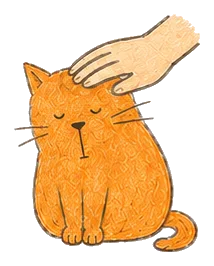
Why does my cat purr when I pet it?
Your cat may enjoy the contact, but pay attention to whether it actively participates. Does it lean into your hand, remain relaxed and return for more? Or does it tense up, turn its head sharply, flick its tail or move away?
Try short, gentle strokes in areas your cat usually enjoys. Pause regularly and allow your cat to choose whether to continue.
Why does my cat purr while sleeping?
Cats may purr while resting or settling down. If the cat looks comfortable and its breathing is normal, this may be part of its usual routine. If the purring is accompanied by laboured or open-mouth breathing, unusual sounds, weakness or obvious distress, seek veterinary advice promptly.
Can purring heal a cat?
You may see claims that purring vibrations heal bones, repair tissue or cure illness. These claims go beyond what owners should rely on. There is scientific interest in the mechanics and possible functions of purring, but it is not a treatment and should never replace veterinary care.
The sound is only one part of the message
Purring can be a lovely part of living with a cat, but it is not a guaranteed happiness signal. Think about the setting, your cat’s body language and whether anything has changed in its normal behaviour.
Want to understand more of your cat’s vocal repertoire? Continue with 12 common cat sounds and their meanings.
The Cat Translator can help you explore possible interpretations of your cat’s sounds. Use it as a curiosity and learning tool alongside careful observation.
Sources and further reading
- Tavernier, C. et al. (2020). “Feline vocal communication.” Journal of Veterinary Science. https://pmc.ncbi.nlm.nih.gov/articles/PMC7000907/
- Ellis, S. et al. (2023). “Vocal communication: The enigmatic production of low-frequency purrs in cats.” Current Biology. https://www.sciencedirect.com/science/article/pii/S0960982223014343
- RSPCA. “Cat body language.” https://nextgen.rspca.org.uk/en/animal-care/cat-body-language